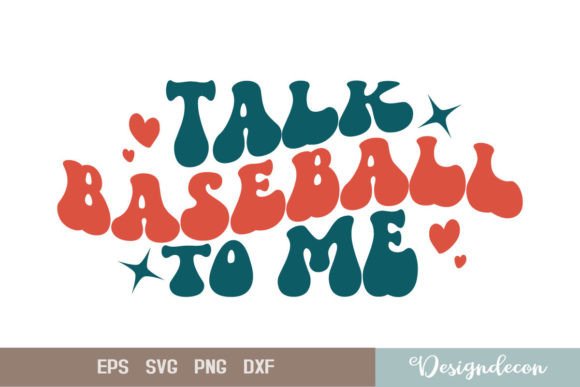
Talk Baseball to Me Retro Wavy SVG
As a designer who’s stitched over 200 custom embroidery projects—from boutique baby onesies to Etsy best-selling tote bags—I opened Talk Baseball to Me Retro Wavy SVG expecting charm, but what stood out immediately was its confident rhythm. This isn’t just retro typography—it’s a wavy, slightly off-kilter baseball quote that leans into mid-century signage energy: friendly but never cutesy, bold but not overwhelming. The curves feel intentional, the spacing generous, and the overall silhouette reads cleanly at a glance—critical when you’re embroidering on a curved cap brim or a textured kitchen towel.
First Stitch, First Impression: Where This Design Naturally Lands
I tested Talk Baseball to Me Retro Wavy SVG as a centerpiece for a limited-run embroidered sweatshirt line for a local youth baseball league. Why? Because it balances team spirit with personality—no generic “Go Team!” here. The wavy baseline gives movement; the thick, rounded letterforms hold up beautifully in satin stitch. It’s instantly recognizable as baseball-themed without relying on bats or gloves—making it ideal for subtle branding on aprons, pillow covers, or even nursery decor where overt sports graphics might feel too loud.
This design thrives in handmade product contexts where authenticity matters: think small shop merchandise, personalized gifts for coaches or dads, holiday embroidery on flannel tea towels, or embroidered patches sewn onto denim jackets. Its clean vector foundation (EPS, SVG, DXF, PNG) means it scales without pixelation—essential whether you’re digitizing for a 3-inch hoop on a baby onesie or expanding to a 6-inch chest logo on a men’s hoodie.
Real-World Embroidery Behavior: What Works—and What Needs Attention
Talk Baseball to Me Retro Wavy SVG performs strongly on stable, medium-weight fabrics like cotton twill, fleece-lined sweatshirts, and canvas totes. On those surfaces, the curves translate smoothly into satin-stitched outlines, and the open counters (like inside the “a” and “e”) stay legible without excessive fill stitch density. I ran it on a lightweight linen tea towel using light tear-away stabilizer—and while the lettering stayed crisp, I did notice slight thread pull on the outermost wave peaks. A quick stabilizer upgrade to cutaway + topping resolved it cleanly.
Where caution is needed: stretchy knits (like jersey t-shirts), ultra-thin baby rib knit, and dark fabric with light thread. The wavy baseline introduces gentle directional tension—on curved surfaces like caps or tapered pillow covers, you’ll want to test placement carefully to avoid distortion at the far ends. Also, while the design avoids tiny serifs or fine connectors, the tightest curve between “k” and “B” sits right at the edge of safe detail for sub-2-inch hoop work. If you’re stitching on a child’s cap or a petite embroidered patch, zoom in and check that junction before finalizing your digitized file.
Design Choices That Build Trust—and Sell More
Customers don’t buy fonts—they buy feeling. Talk Baseball to Me Retro Wavy SVG delivers nostalgia without irony, playfulness without clutter. That translates directly to perceived value: a customer ordering a custom embroidered tote bag with this design doesn’t see “just text”—they see a curated, intentional piece. For Etsy sellers and craft fair vendors, that distinction builds trust. It says, “This wasn’t slapped together—it was chosen.”
For commercial embroidery projects—say, branding for a vintage-style ballpark café—the design holds up across mediums: as an embroidered patch on staff aprons, as a heat-transfer option on takeout bags, or even resized for a subtle corner detail on napkin sets. Its vector flexibility supports consistent brand application, and because it’s built for color change (as noted in the product description), swapping from navy thread on cream canvas to red on black denim takes seconds—not hours.
Practical Designer Notes Before You Stitch
Before committing to a full production run—or listing a finished product online—here’s what I do every time with a new digital embroidery file like Talk Baseball to Me Retro Wavy SVG:
- Test on scrap fabric matching your final substrate—especially if using textured, stretchy, or dark fabric.
- Check thread color contrast early: run a black-and-white mockup to confirm readability on both light and dark backgrounds.
- Verify hoop size compatibility: the full phrase fits comfortably in a 5×7 hoop, but if you’re planning smaller applications (like a baby bib or cap front), isolate and resize key letters only.
- Inspect corners and curves in your embroidery software—look for potential under-stitching or over-dense areas where the wave dips lowest.
- Use appropriate stabilizer: light tear-away for stable wovens, cutaway + topping for knits or delicate weaves.
- Confirm licensing terms before selling finished items or bundling the file with other digital products—this is a Graphics asset, not a commercial-use license by default unless explicitly stated.
Also worth noting: while the listing includes PNGs at 300 dpi and transparent backgrounds—great for printable mockups or digital previews—the real strength lies in the vector files (EPS, SVG, DXF). Those are what give you true control for embroidery digitizing, applique design adaptation, or scaling across Print Templates like labels, tags, or packaging inserts.
Final Thought: A Design That Serves the Maker—and the Customer
Talk Baseball to Me Retro Wavy SVG isn’t flashy. It doesn’t need animation or gradients to earn its place. What it offers instead is quiet reliability: strong visual hierarchy, smart spacing, and a mood that lands whether you’re stitching for a backyard Little League fundraiser or designing a signature piece for your craft business. It works because it respects the medium—embroidery—and the people who use it: designers who value clarity, makers who need flexibility, and customers who respond to sincerity over spectacle.
If you’re evaluating this for your next batch of embroidered patches, holiday gifts, or small shop product line, know this: it’s ready to go—but only if you meet it halfway with thoughtful testing, smart stabilizing, and attention to context. That’s not a limitation. That’s how good design earns its keep.